
The same Control4, Crestron, or Lutron system can land in a house still in framing or in a finished waterfront condo. The experience can be excellent either way. The budget, the disruption, and the decisions that are still cheap are not the same.
In new construction, money goes into capability: racks, shade pockets, speaker locations, keypad heights, conduit for what you have not specified yet. In a retrofit, a large share of the money goes into access: fishing cable, protecting finishes, patching, and working around concrete, HOA rules, and furniture that is already in place.
This guide is the split we use on Miami projects — new builds, gut renovations, and occupied homes — so the platform is chosen after the walls, not the other way around.
The decision is not “smart or not”
Both paths can produce a house that works from a keypad.
What changes:
- How much is wired vs wireless
- Whether shade power and speaker wire are clean or compromised
- Whether the equipment closet exists or has to be invented
- Whether the job is one phase or several years
- How much labor is spent opening the house instead of programming it
Installers commonly see retrofit labor running well above the equivalent new-construction install, because the work is access, not just devices. Treat that as a planning fact, not a fixed percentage.
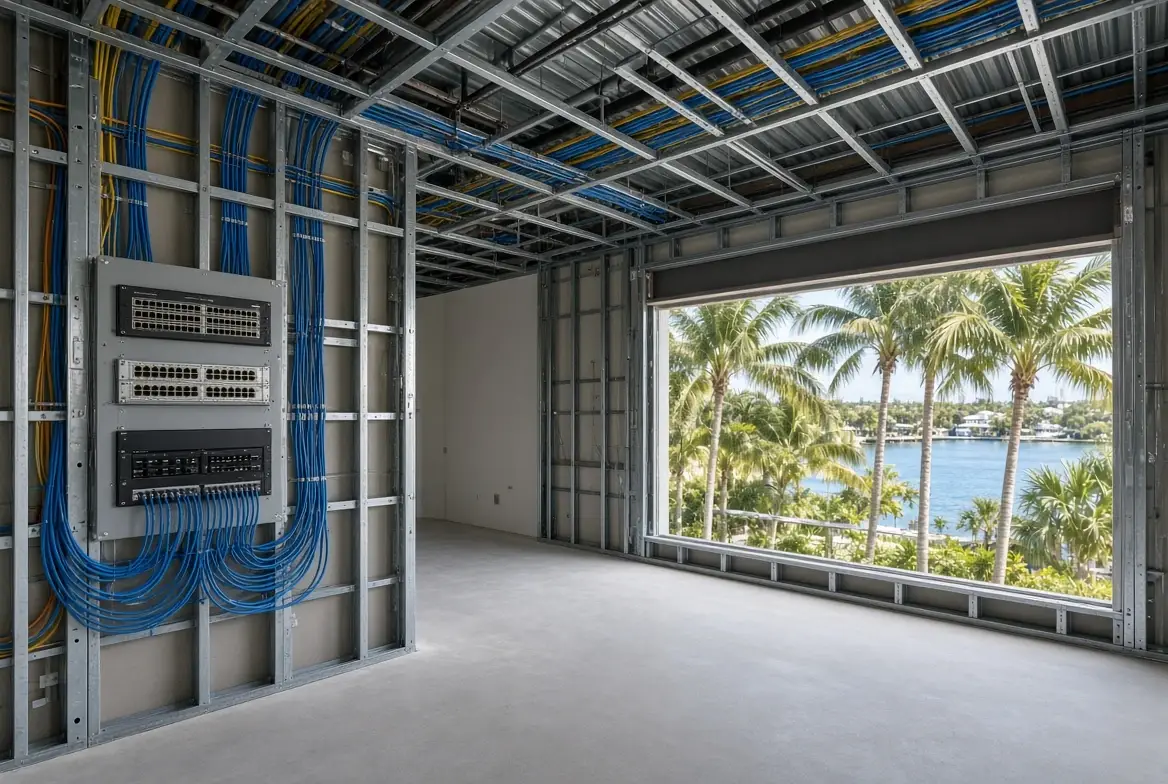
New construction: decide while the walls are open
Open framing is the cheap window. After drywall, every change is a change order.
Specify before the finish schedule locks:
- Equipment location. A real closet or rack space with ventilation, power, and a path for cable. Not a shelf in a bedroom closet next to the water heater.
- Network. Cat6 (or better) home-runs to TVs, access points, cameras, and the rack. Wi-Fi is a service, not the backbone.
- Shade power and pockets. Dual rollers on west and south glass need depth and low-voltage before the ceiling closes.
- Keypad and speaker locations. Heights from the actual door swing and millwork, not a generic electrical plan.
- Conduit. Empty paths to future TV walls, outdoor audio, and shade headers. Conduit is cheap now and expensive later.
- Platform. Control4, Crestron, or Lutron HomeWorks / RadioRA 3 chosen with the architect, not after the electrician has already placed a wall of switches.
In a Miami new build, lighting, shades, and climate should be one design. Afternoon glass is the load. If shade pockets are an afterthought, the AC and the interior pay for it for the life of the house.
HomeWorks and a wired Crestron job belong here when the lighting is architectural. RadioRA 3 and Control4 also belong here — wireless keypads on a properly wired network is a valid new-build spec, not a downgrade.
Retrofit: excellent, if you stop chasing every wire
A finished house in Coral Gables, a Brickell condo, or a 20-year-old waterfront home does not need to be opened to feel controlled.
What usually works without major demolition:
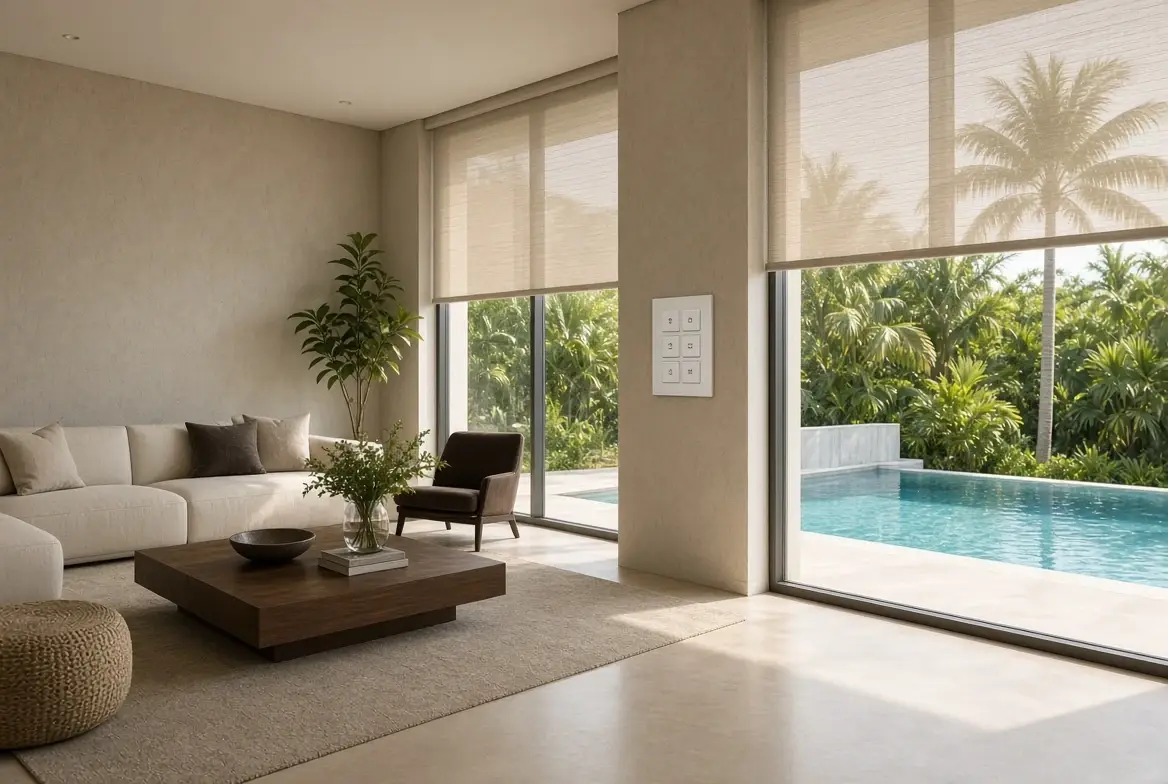
- Lutron RadioRA 3 or Caséta for lights and many shades (Clear Connect, not another Wi-Fi device)
- Control4 over existing AV, locks, thermostats, and Lutron or Somfy
- Battery shades where a low-voltage run is not practical
- A real network upgrade (wired backhaul to access points) even if the rest stays wireless
- Phased rooms — living, primary, outdoor — instead of a whole-house gut
What is still worth a targeted opening:
- Shade power on large sliders if the ceiling is already coming down
- A TV wall that is being rebuilt
- Speaker wire if the ceiling is open for another reason
- A rack if the current “system” is a pile of streamers behind the sofa
Concrete high-rises are the honest constraint. Fishing is limited. RF planning and battery shades matter more than a perfect home-run drawing.
Side by side
| New construction / gut reno | Retrofit | |
|---|---|---|
| Wiring | Clean home-runs, conduit, shade power | Wireless first, selective cable |
| Best platforms | HomeWorks, Crestron, Control4, RadioRA 3 | RadioRA 3, Caséta, Control4, Somfy battery |
| Labor | Lower per system, higher coordination | Higher access cost |
| Disruption | Part of the build | Occupied-home rules |
| Timing | Before drywall | Phased |
| Failure mode | Late integrator, missing pockets | Too many apps, weak Wi-Fi |
What to lock with the builder
If you are the owner or the architect, put these on the drawing set:
- Rack room: size, cooling, dedicated circuits
- Shade pockets and power at every major opening
- Empty conduit to uncertain walls
- Neutral where dimmers need it; note older Miami stock often lacks it — Caséta can help, HomeWorks should be planned
- Outdoor lighting and audio paths before hardscape
- Who programs the system, and when the client is trained
The expensive version of a new build is calling the integrator after the switches are already installed.
What to do if the house is already finished
- Audit what is there: Lutron generation, Control4 OS, network, shade motors.
- Fix the network before adding devices.
- Replace the worst lighting with RadioRA 3 or Caséta instead of Wi-Fi bulbs.
- Motorize the problem windows only.
- Put one processor in charge so voice and apps are not the system.
A retrofit that is phased is usually better than a retrofit that tries to look like a new build in one week.
Frequently Asked Questions
Is a wireless house a compromise?
For lighting and many shades, no. Lutron wireless is a professional system. For distributed video, cameras, and access points, cable still wins.
Can a condo be a real smart home?
Yes. Expect wireless lighting, battery shades, and a tight network plan. Do not expect HomeWorks panel wiring or new speaker home-runs in a concrete slab.
When should shades be decided?
Before the window and ceiling details, on a new build. On a retrofit, before ordering fabric — power and pocket depth still decide the motor.
Should we pick Control4 or Crestron before the walls close?
Pick the platform early enough that keypad locations, rack space, and lighting control are not fighting the electrical plan. The brand can be confirmed in design; the infrastructure cannot wait.
Closing the dilemma
New construction is cheaper where it matters: decisions. Retrofit is more expensive where people dislike spending: opening and repairing the house. Both can end in a keypad that guests can use.
If the walls are open, wire the rack, the glass, and the uncertain walls. If they are closed, use RadioRA, Control4, and battery shades, and only open what another trade is already opening.
Building or renovating in Miami?
Book a design review before drywall — or an audit if the house is already finished. We map Control4, Crestron, and Lutron to the construction stage, not to a catalog.